伸展树md
第01部分 伸展树
一)背景
引入:树的计树问题,一个二叉树可以有多少个形状?例如三个节点的二叉树可以有多少个拓扑形状?
我们可以考虑中序遍历(根节点在中间,依次遍历左子树、根节点、右子树),遍历左子树之前把当前节点PUSH,遍历完成左子树当前节点POP出来。本质就是问 个数字合法的PUSH和POP序列有多少个。
当然,也可以等价思考为一个 的坐标轴网格,起点在,然后每次只能向右或者向上走一步,并且向上走的步数不能多余向右走的步数!也就是说,路线不可以和 有交点。对于与 有交点的路径,把第一个交点之后的路径沿 对称过去,可以发现每一个与 有交点的路径都唯一对应一条从 到 的路径。
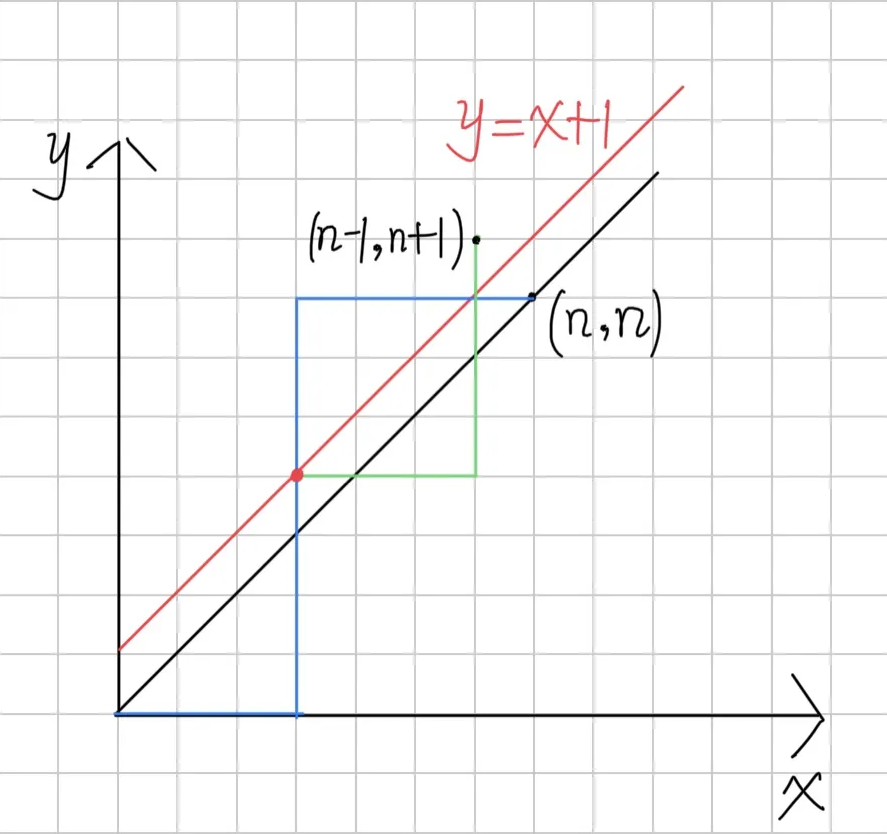
这样的路径一共有 条,也就是说非法的路径是条,总共可能的路径是 条,合法的路径是一共有。
拓展:如果限制条件改为在任一时刻,向右走的次数不能少于(向上走的次数 ± k),只需要把 上下移动即可。(神奇的卡塔兰(Catalan)数 - 知乎 (zhihu.com))
二)伸展树的理论基础
- 对于刚刚访问的数据,很有可能再次被访问,这一现象在信息处理的过程很常见。所以节点V一旦被访问,随机转移到树根。
- 将被访问的下一元素,极有可能就处于不久之前被访问过的某个元素的附近
因此,只需将刚被访问的节点,及时地“转移”至树根(附近),即可加速后续的操作。
三)伸展树的伸展方法
1)直接伸展法
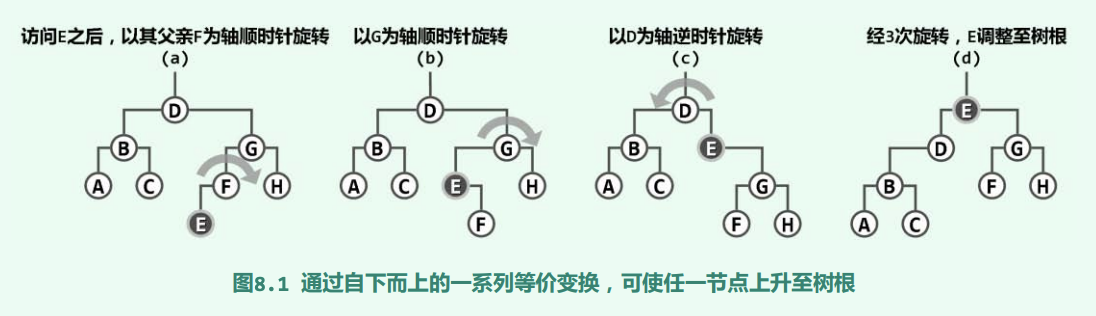
一种直接方式是:每访问过一个节点之后,随即反复地以它的父节点为轴,经适当的旋转将 其提升一层,直至最终成为树根。以图8.1为例,若深度为3的节点E刚被访问,无论查找或插入,甚至“删除”,都可通过3次旋转,将该树等价变换为以E为根的另一棵二叉搜索树。
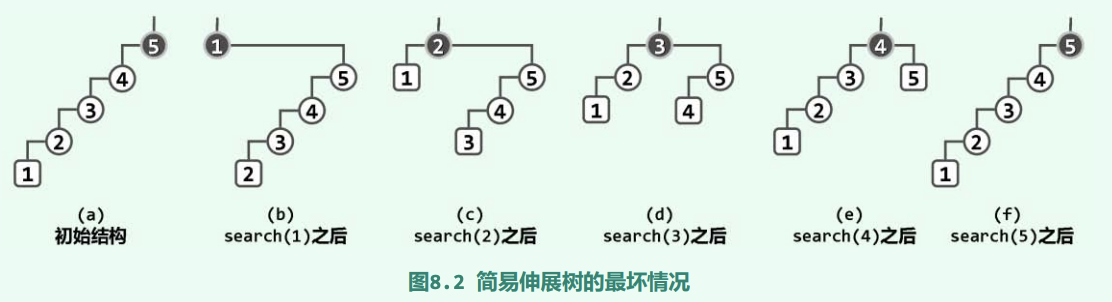
这种方法不好,因为假如依次插入,然后依次搜索,经过一轮搜索之后会还原。这样显然就调整了一个寂寞。若节点总数为 ,则旋转操作的总次数应为(n - 1) + { (n - 1) + (n - 2) + ... + 1 } $,时间复杂度 $n^2。分摊下来,每次访问平均需要 时间
2)双层伸展法
首先我们还是牢记一点,伸展树最终目标是把节点提升到树的根节点,只不过需要分为多次逐步提升,我们分三类情况,分别介绍具体的处理方法。
第一种就是我们常说的LL,目标节点V在g节点的左边的左边(当然g上面还有什么我们不关心,调完之后再说。)
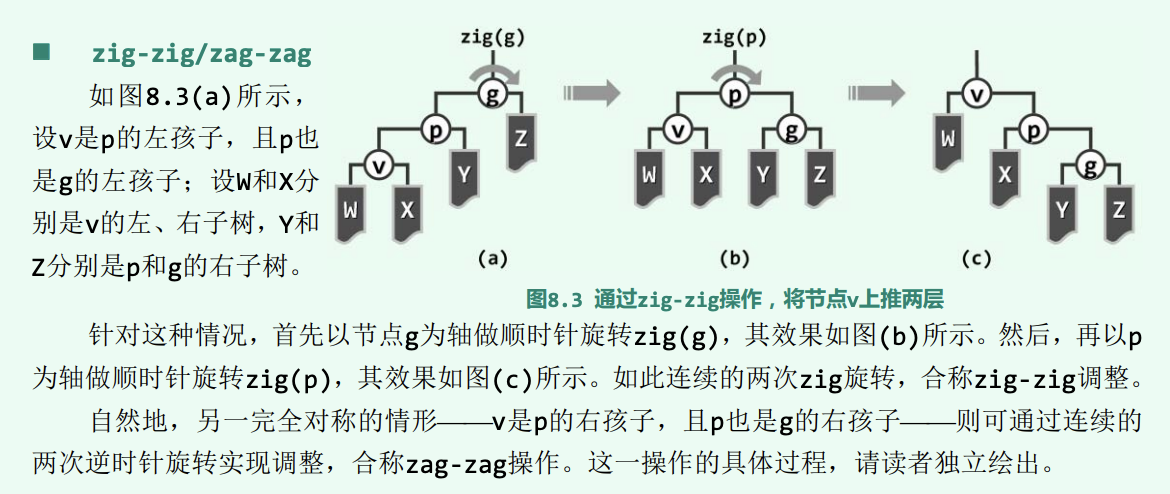
第二种就是RL情况,v节点在g节点的右边的左边。旋转方法是右旋p,然后左旋g。
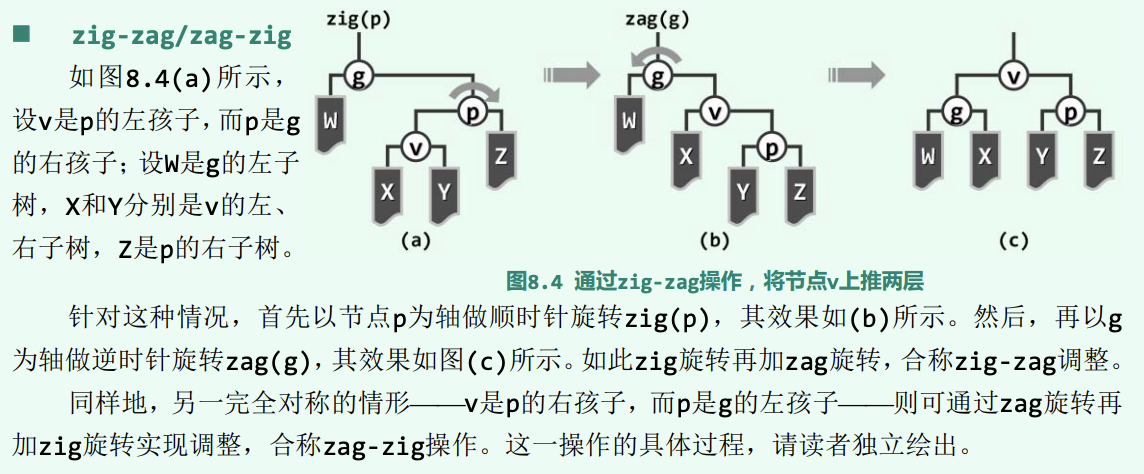
剩下的RR和LR以此类推即可。
第三种就是L或者R,为什么会有这种情况呢?因为上面两种都是把V节点提了两层,那么就要分情况讨论,最后一次提升的时候,是吧节点直接提到了Root节点,还是Root的一个儿子节点呢,所以这时候需要考虑提升一层的情况。如下所示
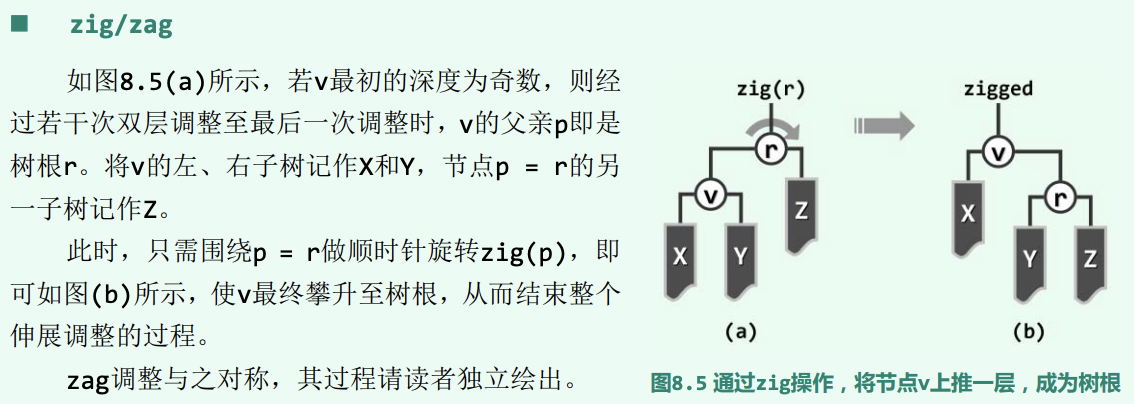
势能分析法(potential analysis)业已证明,在改用“双 层伸展”策略之后,伸展树的单次操作均可在分摊的 的时间内完成。
d)伸展树的算法实现
1)查找算法
查找算法实现:
- 在伸展树中查找Key
- 将最后一个被访问的节点伸展至根
调用二叉搜索树的通用算法searchIn()尝试查找具有关键码e的节点。 无论查找是否成功,都继而调用splay()算法,将查找终止位置处的节点伸展到树根。
template <typename T> BinNodePosi(T) & Splay<T>::search(const T& e) {
        //在伸展树中查找关键码e
        BinNodePosi(T) p = searchIn(_root, e, _hot = NULL);
        _root = splay((p ? p : _hot)); //将最后一个被讵问癿节点伸展至根
        return _root;
}
2)插入算法
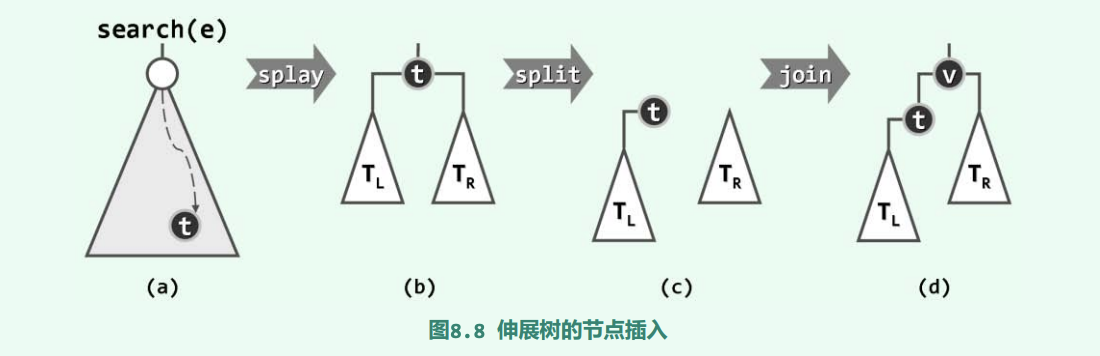
为将关键码e插至伸展树T中,首先调用伸展树查找接口Splay::search(e), 查找该关键码(图(a))。于是,其中最后被访问的节点t,将通过伸展被提升为树根,其左、 右子树分别记作 和 (图(b))。
接下来,根据 与 的大小关系(不妨排除二者相等的情况),以 为界将 分裂为两棵子树。 比如,不失一般性地设 大于 。于是,可切断t与其右孩子之间的联系(图(c)),再将以 为关键码的新节点 作为树根,并以t作为其左孩子,以 作为其右子树(图(d))。
3)删除算法
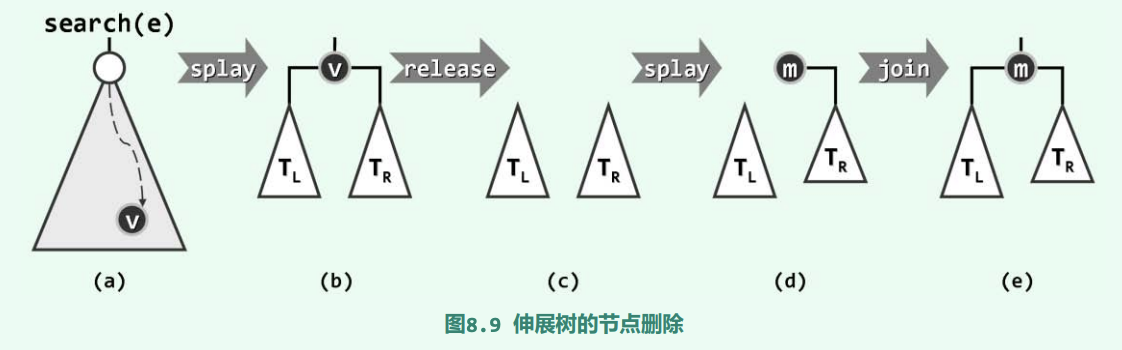
如下图所示,为了从伸展树 中删除关键码为 的节点,首先亦调用接口Splay::search(e), 查找该关键码,且不妨设命中节点为 图(a))。于是, 将随即通过伸展被提升为树根,其左、 右子树分别记作和(图(b))。接下来,将 摘除(图(c))。然后,在 中再次查找关键码 。 尽管这一查找注定失败,却可以将 中的最小节点 ,伸展提升为该子树的根。最后把 和左子树接上即可!
e)伸展树的代码
一种可能的代码实现如下所示:
/**
 * 代码来源:https://github.com/BigWheel92/Splay-Tree/blob/master/SplayTree.h
 * 向仓库作者致谢!
*/

#pragma once

#include <iostream>
#include <queue>
using namespace std;

template <typename k, typename v>
struct SplayNode
{
    k key;
    v value;
    SplayNode<k, v>* lChild,
        * rChild,
        * parent;

    SplayNode()
    {
        this->lChild = this->rChild = this->parent = nullptr;
    }

    bool isLeafNode()
    {
        return (!lChild && !rChild);
    }

};


template <typename k, typename v>
class SplayTree
{
    SplayNode<k, v>* root;

    void deleteAll(SplayNode<k, v>* node)
    {
        if (node == nullptr)
            return;

        deleteAll(node->lChild);
        deleteAll(node->rChild);
        delete node;
    }

    void inOrderPrintKeys(SplayNode<k, v>* node) const
    {
        if (node == nullptr)
            return;
        inOrderPrintKeys(node->lChild);
        cout << node->key << ", ";
        inOrderPrintKeys(node->rChild);

    }

    v const* search(SplayNode<k, v>* node, k key)
    {
        if (node->key == key) //key has been found, so splay the node containing this key, and then return the pointer to the value.
        {
            this->splay(node);
            return &root->value;
        }

        if (node->lChild == nullptr && key < node->key) //key does not exist so splay the last accessed node
        {
            this->splay(node);
            return nullptr;
        }

        else if (node->rChild == nullptr && key > node->key) //key does not exist so splay the last accessed node
        {
            this->splay(node);
            return nullptr;
        }

        else if (key < node->key)
        {
            return search(node->lChild, key);
        }

        else
        {
            return search(node->rChild, key);
        }

    }


    void deleteKey(SplayNode<k, v>*& current, k const key)
    {
        //the key to delete does not exist in the tree, so splay the last access node and return from the function.
        if ((key > current->key&& current->rChild == nullptr) || (key < current->key && current->lChild == nullptr))
        {
            splay(current);
            return;
        }

        else if (key > current->key)
        {   //move to the right subtree
            deleteKey(current->rChild, key);
            return;
        }

        else if (key < current->key)
        {   //move to the left subtree
            deleteKey(current->lChild, key);
            return;
        }
        else //current node has the key that we need to delete
        {

            //case 1: the node to delete is the leaf node.
            if (current->isLeafNode() == true)
            {

                SplayNode<k, v>* parent = current->parent;
                delete current;
                current = nullptr;
                splay(parent);
                return;
            }//end of case 1

            //case 2: one of the subtrees of current is nullptr;
            else if (current->lChild == nullptr || current->rChild == nullptr)
            {
                if (current->lChild == nullptr)
                {
                    SplayNode<k, v>* nodeToDelete = current;
                    SplayNode<k, v>* parent = current->parent;
                    current = current->rChild;
                    current->parent = parent;
                    splay(current->parent);

                    delete nodeToDelete;
                    return;
                }

                else //right child is nullptr, but left child is not
                {
                    SplayNode<k, v>* nodeToDelete = current;
                    SplayNode<k, v>* parent = current->parent;
                    current = current->lChild;
                    current->parent = parent;
                    splay(current->parent);

                    delete nodeToDelete;
                    return;
                }

            }//end of case 2

            else  //case 3: none of the subtrees of node to delete is nullptr.
            {
                SplayNode<k, v>* newNodeToDelete = current->rChild;

                while (newNodeToDelete->lChild != nullptr)
                {
                    newNodeToDelete = newNodeToDelete->lChild;
                }

                current->key = newNodeToDelete->key;
                current->value = newNodeToDelete->value;

                //in this new recursive call, case 0 and 3 will never exist. Only case 1 or case 2 will exist.
                deleteKey(current->rChild, current->key);
            }//end of case 3.
        }
    }

    void insert(SplayNode<k, v>* node, k key, v value)
    {
        if (node == nullptr)
        {
            root = new SplayNode<k, v>;
            root->key = key;
            root->value = value;
            return;
        }

        if (node->lChild == nullptr && node->key > key)
        {
            node->lChild = new SplayNode<k, v>();
            node->lChild->key = key;
            node->lChild->value = value;
            node->lChild->parent = node;
            this->splay(node->lChild);
            return;
        }

        else if (node->rChild == nullptr && key > node->key)
        {
            node->rChild = new SplayNode<k, v>();
            node->rChild->key = key;
            node->rChild->value = value;
            node->rChild->parent = node;
            this->splay(node->rChild);
            return;
        }


        else if (key < node->key)
        {
            insert(node->lChild, key, value);
        }

        else if (key > node->key)
        {
            insert(node->rChild, key, value);
        }

        else  //duplicate key, so update the value
        {
            node->value = value;
            this->splay(node);
            return;
        }

    }

    /*T1, T2and T3 are subtrees of the tree
        rooted with y(on the left side) or x(on
            the right side)
           y                               x
          / \       Right Rotation        / \
         x   T3        ------->         T1   y
        / \            <-------             / \
        T1  T2       Left Rotation         T2  T3
    */

    SplayNode<k, v>* rightRotate(SplayNode<k, v>* node)
    {
        SplayNode<k, v>* y = node;
        SplayNode<k, v>* yParent = node->parent;
        SplayNode<k, v>* x = y->lChild;
        //SplayNode<k, v> T3 = y->rChild;
        //SplayNode<k, v> T1 = x->lChild;
        SplayNode<k, v>* T2 = x->rChild;


        x->rChild = y;
        y->parent = x;

        y->lChild = T2;

        if (T2 != nullptr)
            T2->parent = y;


        x->parent = yParent;;

        if (x->parent != nullptr)
        {
            if (x->parent->lChild == y) //y is the old child of x's new parent (yParent)
                x->parent->lChild = x;

            else x->parent->rChild = x;

        }
        return x;

    }

    SplayNode<k, v>* leftRotate(SplayNode<k, v>* node)
    {
        SplayNode<k, v>* x = node;
        SplayNode<k, v>* xParent = node->parent;
        SplayNode<k, v>* y = x->rChild;
        SplayNode<k, v>* T2 = y->lChild;

        y->lChild = x;
        x->parent = y;

        x->rChild = T2;

        if (T2 != nullptr)
            T2->parent = x;

        y->parent = xParent;

        if (y->parent != nullptr)
        {
            if (y->parent->lChild == x)  //x is the old child of y's new parent (xParent)
                y->parent->lChild = y;

            else y->parent->rChild = y;
        }
        return y;
    }

    void splay(SplayNode<k, v>* curr)
    {

        if (curr == root || curr == nullptr)
            return;


        //pictorial help for cases: https://www.geeksforgeeks.org/splay-tree-set-1-insert/

        //zig case
        if (curr->parent == root)
        {
            if (curr->parent->lChild == curr)
            {
                root = rightRotate(root);
            }

            else
                root = leftRotate(root);

            return;
        }//end of zig case

        //zig zig case
        else if (curr->parent->lChild == curr && curr->parent->parent->lChild == curr->parent)
        {
            if (curr->parent->parent == root)
            {
                //root ptr of tree will be passed by reference, so root ptr of tree will also change.
                root = rightRotate(root);
                root = rightRotate(root);
                return;
            }
            else
            {
                curr->parent = rightRotate(curr->parent->parent);
                curr = rightRotate(curr->parent);

                splay(curr);
                return;
            }
        } //end of zig zig case

        //zag zag case
        else if (curr->parent->rChild == curr && curr->parent->parent->rChild == curr->parent)
        {
            if (curr->parent->parent == root)
            {

                root = leftRotate(root);
                root = leftRotate(root);
                return;
            }
            else
            {
                curr->parent = leftRotate(curr->parent->parent);
                curr = leftRotate(curr->parent);

                splay(curr);
                return;
            }
        } //end of zag zag case

        //zag-zig cases
        else if (curr->parent->rChild == curr && curr->parent->parent->lChild == curr->parent)
        {
            curr = leftRotate(curr->parent);

            if (curr->parent == root)
            {
                root = rightRotate(root);
                return;
            }
            else
            {
                curr = rightRotate(curr->parent);
                splay(curr);
                return;

            }
        } //end of zag zig case

        //zig zag case
        else if (curr->parent->lChild == curr && curr->parent->parent->rChild == curr->parent)
        {
            curr = rightRotate(curr->parent);

            if (curr->parent == root)
            {
                root = leftRotate(root);
                return;
            }
            else
            {
                curr = leftRotate(curr->parent);
                splay(curr);
                return;

            }

        }
    }//end of splay function

public:

    SplayTree()
    {
        this->root = nullptr;
    }

    void inOrderPrintKeys() const
    {

        inOrderPrintKeys(root);
        cout << endl;
    }
    void levelOrderPrintKeys() const
    {
        queue<SplayNode<k, v>*> nodeQueue;

        if (root != nullptr)
            nodeQueue.push(root);

        while (nodeQueue.empty() == false)
        {
            SplayNode<k, v>* n = nodeQueue.front();
            nodeQueue.pop();

            if (n->lChild != nullptr)
                nodeQueue.push(n->lChild);

            if (n->rChild != nullptr)
                nodeQueue.push(n->rChild);

            cout << n->key << (nodeQueue.empty() == false ? ", " : "\n");

        }
    }

    void insert(k const key, v const value)
    {

        this->insert(root, key, value);
    }

    void deleteKey(k const key)
    {
        this->deleteKey(this->root, key);
    }

    v const* search(k const key)
    {
        return this->search(root, key);
    }

    void deleteAll()
    {
        deleteAll(this->root);
        this->root = nullptr;
    }

    ~SplayTree()
    {
        deleteAll(this->root);
    }
};